
English 
Room501, Building32, No. 518 Xinzhuan Highway, Songjiang District, Shanghai, China 201612
Views: 0 Author: Site Editor Publish Time: 2026-01-08 Origin: Site


You might ask, "What is the difference between Inconel and Incoloy?" The main difference lies in how each alloy performs under stress. Inconel contains a higher percentage of nickel, while Incoloy has a greater iron content. They also respond differently when exposed to heat and corrosion. Understanding these differences is essential for selecting the right alloy for your application. Bozhong offers both options, providing you with excellent choices for durable materials.
Inconel has more nickel. This makes it stronger in high heat. Pick Inconel for very hot places.
Incoloy has more iron. This makes it cheaper and easier to shape. Use Incoloy for long jobs in tough places.
Both alloys fight rust, but Inconel does better in harsh spots. Think about where you will use the alloy.
Inconel works best in planes and oil fields. Incoloy is good for chemical plants and power stations. Pick the alloy that fits your job.
Talk to experts like Bozhong to pick the right alloy. Their help can save you time and money.
The biggest difference between inconel and incoloy alloys is what they are made of. Inconel alloys have a lot of nickel, usually more than 60%. Incoloy alloys have more iron, so they act differently. Both are nickel-based alloys, but their mix of metals makes them special.
Here is a simple table to help you compare:
| Alloy Type | Main Elements | Nickel Content | Iron Content | Typical Use |
|---|---|---|---|---|
| Inconel | Nickel, Chromium, Molybdenum | 58–72% | Low | Aerospace, Oil & Gas |
| Incoloy | Nickel, Iron, Chromium | 30–46% | High | Chemical Processing, Power |
Inconel alloys use lots of nickel for strength and to stop rust. Incoloy alloys use more iron, which helps them last longer. Both types are nickel-based alloys, but incoloy is often called a nickel-iron-chromium alloy because it has more iron.
Inconel alloys and incoloy alloys act differently when they get hot or are under pressure. Inconel alloys stay strong even at high temperatures. Incoloy alloys work well for a long time when exposed to heat and chemicals.
Here is a table that compares their mechanical properties:
| Property | Inconel Alloys | Incoloy Alloys |
|---|---|---|
| Yield Strength (MPa) | 280 – 1,200 | 240 – 600 |
| Ultimate Tensile Strength (MPa) | 700 – 1,200 | 485 – 690 |
Inconel alloys have higher yield and tensile strength. This makes them good for tough places like jet engines or oil rigs. Incoloy alloys are better when you need steady performance for many years, like in heat exchangers or chemical plants.
The uses for each alloy are different:
| Alloy Type | Common Applications | Industry Sector |
|---|---|---|
| Inconel | Aerospace components, oil and gas systems | Aerospace, Oil and Gas |
| Incoloy | Chemical processing, high-temperature use | Chemical Processing |
Think about where you will use the alloy before you choose. If you need something strong at very high temperatures, pick inconel alloys. If you want something that lasts a long time in hot or harsh places, incoloy alloys are a good choice.
Bozhong sells both inconel alloys and incoloy alloys with ASTM-certified quality. Their products meet international standards like UNS, AMS, ASTM, and DIN. Bozhong also has ISO9001:2000 certification and other quality marks from TuV, LRS, GL, and CE. You get reliable nickel-based alloys for your project, with expert help and strict quality checks.
Inconel is special because of what it is made of. Most inconel grades have a lot of nickel, between 58% and 72%. Chromium is also in inconel, from 14% to 23%. Iron makes up about 5% to 10%. There are small amounts of molybdenum, niobium, aluminum, and titanium. Nickel helps inconel fight rust and stay strong when hot. Chromium protects the outside from getting damaged by air. Molybdenum and niobium help stop cracks and pits.
Here is a table that shows what is in some inconel grades:
| Inconel Grade | Nickel (%) | Chromium (%) | Iron (%) | Molybdenum (%) | Niobium (%) |
|---|---|---|---|---|---|
| 600 | ≥72.0 | 14–17 | 6–10 | 0 | 0 |
| 625 | ≥58.0 | 20–23 | 5 | 8–10 | 3.15–4.15 |
| 718 | 50–55 | 17–21 | 18 | 2.8–3.3 | 4.75–5.5 |
Bozhong sells inconel in plates, sheets, bars, pipes, and wires. You can pick the type and grade that works for your job.
Inconel stays strong even when it gets very hot. You can use it where other metals break down. Inconel keeps its strength above 1000°C. For example, inconel 625 works up to 982°C. Inconel 718 works up to 980°C. This makes inconel great for places with lots of heat.
Inconel also does well against rust and damage from chemicals. It gets a score of 9 out of 10 for fighting corrosion. This is better than stainless steel and many other alloys. You can see how inconel compares in this chart:
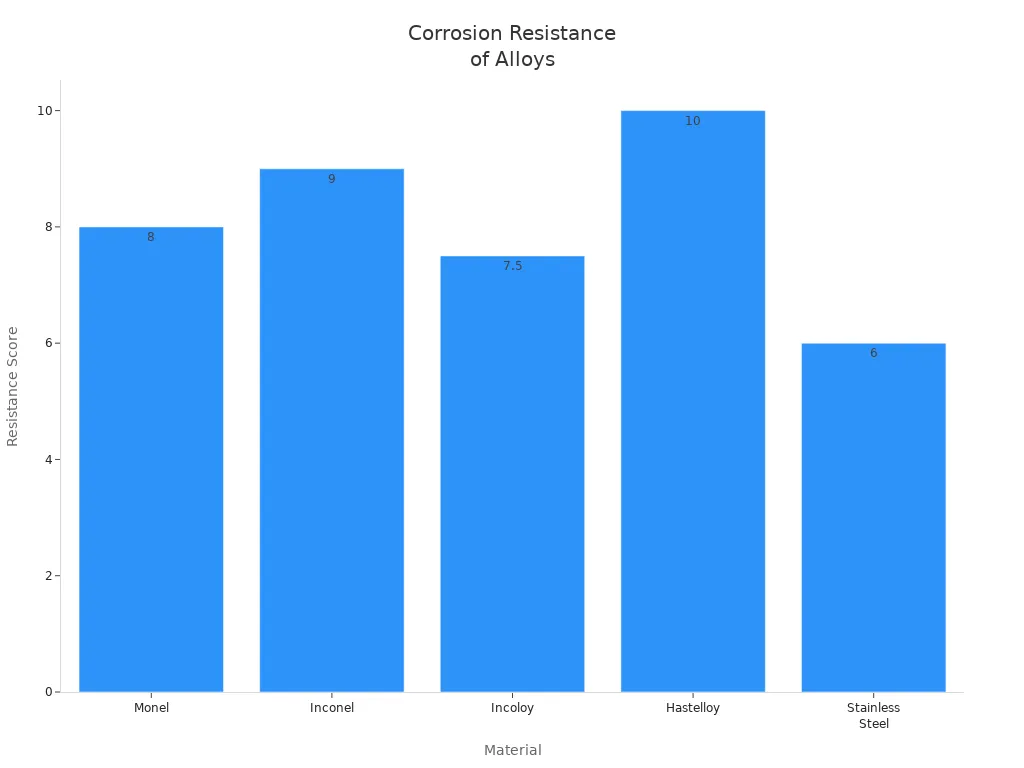
You can count on inconel to stand up to rust, acids, and strong chemicals. This makes it a good choice for tough places.
Inconel is used in many jobs. Here are some examples:
Aerospace: Inconel is needed for jet engines and turbine blades. These parts get very hot and stressed.
Oil and Gas: Inconel works in drilling tools and pipes. It handles high pressure and bad fluids.
Chemical Processing: Inconel is used in reactors and heat exchangers. It fights strong acids and lasts for years.
Pollution Control: Inconel helps in scrubbers and waste systems.
Marine: Inconel is found in ship parts that need to resist seawater.
Bozhong gives you inconel alloys with ASTM-certified quality. You get custom shapes and quick delivery. You can trust Bozhong for help and good inconel products.
Tip: If you need something strong and safe from rust in hard places, inconel is a smart pick.
Incoloy is special because it has nickel, chromium, and iron. These metals help incoloy stay strong when it gets hot. Nickel helps incoloy fight heat. Chromium keeps it safe from rust and damage. Iron makes incoloy tough and helps it keep its shape. This mix makes incoloy good for machines that work in hard places every day.
Incoloy works well for a long time. It can handle heat up to 700°C (1292°F). This is good for many factory jobs. Here is a table that shows how it compares:
| Alloy Type | Temperature Resistance | Applications |
|---|---|---|
| Inconel | Over 1000°C | Aerospace, gas turbines |
| Incoloy | Up to 700°C | Jobs with lots of heat |
Incoloy also helps you save money. It costs less than some other alloys. This makes it a smart pick for big jobs:
| Alloy Type | Cost Category |
|---|---|
| Incoloy | Cheaper |
| Inconel | More Expensive |
You get good value and strong performance. Incoloy is great when you need machines to last for years.
Incoloy is used in many places because it is strong, fights rust, and lasts long. People use it for:
Heat exchangers
Petrochemical machines
Big ovens
Power plants
Chemical factories
Ships and boats
Incoloy 825 is very good for chemical jobs. It can handle heat, pressure, and strong acids. Molybdenum helps it fight bad types of rust. Chromium keeps it safe from things that cause damage. Bozhong suggests using Incoloy 800 and 825 for heat exchangers and chemical plants. You can buy incoloy as plates, bars, pipes, or special parts. Bozhong will help you pick the right incoloy and send it fast.
Tip: If you want something that lasts, saves money, and works in tough places, incoloy is a smart choice.
You should think about how each alloy works in hard places. Inconel and Incoloy both fight heat and chemicals well. But they act differently when things get really tough. Inconel is best when you need strength at very high heat. It works in jet engines and nuclear reactors. Incoloy is good for long use in hot and harsh spots. It is used in nuclear parts and chemical plants.
Here is a table that shows how these alloys do in different places:
| Alloy | Temperature (°C) | Environment | Performance Summary |
|---|---|---|---|
| Inconel 617 | 750 | Helium atmosphere | Gets weaker from carburization. |
| Incoloy 800H | 750 | Helium atmosphere | Stays strong because of a silicon oxide layer. |
| Inconel 617 | 950 | Graphite dust-coated | Loses strength and stretch from carbon moving inside. |
| Incoloy 800H | 950 | Graphite dust-coated | Keeps its properties because the surface blocks carbon. |
Studies found that Incoloy 800H makes a double oxide layer. This helps it fight oxidation better than Inconel 617.
You should also think about cost and how easy it is to shape or weld. Inconel is harder and needs special tools to work with. Incoloy is easier to shape and weld. You can make complex parts with it. This saves time and money for big jobs.
| Alloy Type | Fabrication Challenges |
|---|---|
| Inconel | Hard to machine and weld. Needs special ways to work. |
| Incoloy | Easier to shape, weld, and form. Good for making tricky parts. |
Incoloy usually costs less than Inconel. If you want good resistance and easy shaping, Incoloy is a smart pick for many jobs.
Pick the alloy that fits your job. If you need top strength in very hot or nuclear places, choose Inconel. If you want long life, lower cost, and good resistance in nuclear parts, pick Incoloy.
Bozhong can help you choose the right alloy. Their experts know a lot about nickel-based alloys. Bozhong offers custom shapes, strict checks, and fast shipping everywhere.
| Service Type | Description |
|---|---|
| Technical Support | Get help picking the best alloy for your needs. |
| Custom Processing | Order alloys in the shapes and sizes you want. |
| Global Logistics Network | Get your materials quickly, no matter where you are. |
Tip: Always ask a Bozhong expert before you choose. The right alloy will help your project work better and save money.
You have learned that Inconel alloys are very strong and last long in high heat. Incoloy alloys are cheaper and easier to shape for things used a long time. Look at this table to compare them:
| Feature | Inconel Alloys | Incoloy Alloys |
|---|---|---|
| Composition | High nickel, chromium | Nickel-iron-chromium |
| Properties | Extreme heat, corrosion resistance | Good oxidation, easy to shape |
| Applications | Aerospace, chemical, marine | Oil & gas, power, marine |
Talk to experts, think about what you need, and check Bozhong’s Nickel Alloy Resource Center for help. Picking the right alloy helps your project work better and saves money later.
You will find that Inconel has more nickel, while Incoloy has more iron. This makes Inconel stronger at high temperatures. Incoloy works better for long-term use and costs less.
You can weld both alloys with the right methods. Inconel needs special care because it is harder. Incoloy is easier to weld and shape.
You should use Inconel in places with extreme heat or strong chemicals, like jet engines or reactors. Incoloy fits best in heat exchangers, power plants, or chemical factories.
Most Inconel and Incoloy alloys are not magnetic. You can check with a magnet, but usually, they do not stick.
Tip: Think about temperature, cost, and how long you need the part to last. You can ask Bozhong’s experts for help. They will guide you to the best choice.


