
English 
Room501, Building32, No. 518 Xinzhuan Highway, Songjiang District, Shanghai, China 201612
Views: 0 Author: Site Editor Publish Time: 2026-01-06 Origin: Site


You can use this Metallurgy Encyclopedia - Quick Reference to Common Metal Terms to find easy definitions fast. The glossary lets you look up words in order, so you save time and get the facts you want. Shanghai Bozhong Metal Group Co., Ltd. is a trusted place for nickel-based alloys and metallurgy knowledge. Many words are used in factories and schools, such as:
Alloy
Annealing
Casting
Corrosion
Forging
Hardening
Tempering
Welding
This tool gives you helpful answers for your job or homework.
Alloys are important in our daily lives. They mix metals to make new things, so they are stronger and can be used in more ways.
Learning about heat treatment like annealing and tempering can make metal work better. These ways make metal stronger and less likely to break.
Picking the right alloy is very important for each job. Nickel-based alloys do not rust easily and can take high heat, so they are good for tough places.
Checking and testing metals often keeps them good. Tests like tensile and hardness tests make sure materials are safe and work well.
Keep learning about metallurgical words and what they mean. Knowing words like ductility, toughness, and yield strength helps you pick the best materials for your work.
Alloys are everywhere in life and industry. An alloy is made by mixing two or more metals, or a metal with another element. Mixing metals gives new properties. Steel is an alloy of iron and carbon. Brass is made from copper and zinc. Bronze is copper mixed with tin. Aluminum alloys are strong and light, so they are used in cars and planes. Titanium alloys do not rust easily and are used in medical tools. Nickel alloys, like those from Bozhong, can handle heat and tough places. Copper-nickel alloys are used in electronics and boats.
Common alloys and what they are used for:
Steel: Used in buildings, ships, cars, tools, and medical tools.
Brass: Used for buttons, hardware, and boat parts.
Bronze: Used for statues, gears, and tools.
Aluminum alloys: Used in cars, planes, and electronics.
Titanium alloys: Used in planes and medical tools.
Nickel alloys: Used in turbines and machines.
Copper-nickel alloys: Used in electronics and boats.
Annealing is a way to heat metal to make it softer. You heat the metal, keep it hot, then cool it slowly. This changes the metal inside and removes stress. Annealing makes metal easier to bend and less likely to break. It is often used when making steel. The heat needed depends on the steel type.
| Type of Steel | Temperature Range (°C) | Temperature Range (°F) |
|---|---|---|
| Low-Carbon Steel | 450-600 | 842-1112 |
| High-Carbon Steel | 600-700 | 1112-1292 |
Annealing helps get alloys ready for shaping or cutting. Bozhong uses special annealing to make sure nickel alloys are high quality.
Austenite is a crystal structure found in some steels and alloys. You find austenite in stainless steel, mostly when it is hot. Some steels keep a little austenite at room temperature. This helps make steel tougher, even when it is cold. By changing heat treatment, you can control how much austenite is in steel.
Important things about austenite:
How much austenite stays at room temperature depends on its stability.
Low carbon martensitic stainless steels have both α′ and γ structures, which help toughness in cold.
If there is about 15% austenite left, small carbides form. With 30% austenite, there are fewer carbides.
If austenite goes from 13% to 35%, the strength drops by almost half.
Abrasion is when metal wears away from rubbing against something else. You want high abrasion resistance in parts that rub a lot, like gears or mining tools. Abrasion resistance helps metal parts last longer. If a part resists abrasion, you do not need to replace it as often. Bozhong’s nickel alloys resist abrasion well, so they are good for hard jobs.
Tip: Pick alloys with high abrasion resistance for equipment that lasts longer.
Aging is a process that changes how strong or hard an alloy is after it is made or heated. You let the metal stay at a set temperature for some time. This changes the inside of the metal and can make it stronger. In nickel alloys, aging can make the grains stronger and raise yield strength. The Hall–Petch relationship says smaller grains make metals stronger. Aging can increase yield strength by 125–170 MPa, depending on grain size and other things.
How aging helps alloys:
Grain boundary strengthening stops movement inside the metal.
Solid solution strengthening makes the alloy tougher.
Aging helps balance strength and toughness.
A billet is a partly finished piece of metal used to make bars, wires, and other things. Billets are usually square, rectangle, or round. They are smaller than blooms and are good for making rebar and steel wire.
| Size | Type |
|---|---|
| 100 mm x 100 mm | Square |
| 120 mm x 120 mm | Square |
| 140 mm x 140 mm | Square |
| 160 mm x 160 mm | Square |
| 200 mm x 200 mm | Square |
| 220 mm x 250 mm | Rectangular |
| 280 mm x 140 mm | Rectangular |
| 300 mm x 160 mm | Rectangular |
| 300 mm x 300 mm | Square |
| 300 mm x 400 mm | Rectangular |
| 150 mm | Round |
| 250 mm | Round |
Bozhong has billets in many sizes for your needs.
A bloom is a big, partly finished metal piece. Blooms are used to make heavy beams and big shapes for buildings. Blooms are bigger than billets. The blooming process shapes steel into large pieces for building things. Billets are smaller and used for rebar and wire.
Blooms: Used for heavy beams and big shapes.
Billets: Used for rebar and steel wire.
Brittleness means a metal breaks easily and does not bend much. You do not want brittleness in most uses. Brittleness can be caused by the metal’s structure, what it is made of, and the environment. More carbon makes metals more brittle. Hydrogen can also make steel brittle, especially in wet places.
| Cause of Brittleness | Explanation |
|---|---|
| Microstructural features | Hard to move inside the crystal, so metal is brittle. |
| Chemical composition | More carbon raises the brittle temperature by 10-15°C for each 0.1% added. |
| Environmental factors | Even a little hydrogen can make steel brittle in humid places. |
You can make metals less brittle by heat treating, making grains smaller, and controlling small elements.
Ways to make metals less brittle:
Use heat treatment to remove stress.
Make grains smaller for better toughness.
Design alloys to limit phosphorus and sulfur.
A Basic Oxygen Furnace is a main tool for making steel. You blow oxygen into hot iron to remove bad stuff and make steel. About 67% of the world’s steel is made this way. This method is fast and works well in big factories.
BOF makes most of the world’s steel.
You use BOF for good steel and alloys.
Bozhong sells many nickel alloys and other metals for industry. You can get products like Inconel, Hastelloy, Monel, and Incoloy. These alloys meet ASTM rules and work in tough places. You can pick sheets, bars, coils, tubes, and wires. Bozhong offers custom sizes and surface finishes for your needs.
| Product Category | Description | Industry Standard Comparison |
|---|---|---|
| W 1.2312 prehardened mold steel | Used in plastic molds, easy to machine. | Easier to machine than other grades. |
| Stainless steel sheets, pipes, bars, | Many shapes for different uses. | Meets rules for strength and not rusting. |
| and coils | ||
| Products for mining, oil and gas, | Supplies for mining, oil, gas, chemical, power, and military industries. | Follows strict industry rules. |
You can trust Bozhong for good alloys and metals for planes, ships, and chemical plants. The metallurgy encyclopedia - quick reference helps you learn about these products and how to use them.
Decarburization happens when steel is heated and loses carbon at the surface. This makes the steel weaker and less hard. It often happens during heat treatment. Iron reacts with gases like hydrogen or oxygen. The decarburization layer can be about 0.8 mm deep. At 200 μm, the carbon drops to 0.2 percent. You must control decarburization to keep steel strong for tools.
Ductility means you can pull metal into wires without breaking it. Nickel-based alloys have different ductility based on their structure. If the μ phase gets bigger, the alloy cannot harden as much. This changes how the metal bends and stretches. Good ductility is needed for wires, sheets, and parts that bend.
Electrodes are used to join or melt metals in metallurgy. Common electrodes are copper tungsten, silver tungsten, and pure tungsten. Copper tungsten does not crack and lasts longer in welding. Silver tungsten is good for fast, automatic welding jobs. Pure tungsten works at high heat and welds non-ferrous metals. These electrodes help make better welds in steel and nickel alloys.
Ferrite is a crystal structure in iron and steel. Duplex stainless steels have about half ferrite. This gives high strength and stops chloride stress corrosion cracking. Too much ferrite lowers toughness. Too little ferrite lowers corrosion resistance. You need the right ferrite amount for strong metals.
Ferrite content in duplex stainless steels:
Best: 50%
Okay: 35%–60%
Too much: Less tough
Too little: Less corrosion resistance
Forging shapes metal by pressing or hammering it. You use forging to make steel and nickel alloy parts for planes, cars, and power plants. Forged parts are strong and resist wear. In energy plants, forged nickel alloys last longer in tough places. Forged metals give better safety and work well.
Forging nickel-based alloys helps:
Turbines work at high heat
Engines resist wear
Military gear resists corrosion
Grain size changes how strong and tough metals are. Small grains make steel stronger and raise yield strength. Big grains make metal more ductile. The Hall-Petch rule says finer grains mean stronger steel. You want the right grain size for both strength and toughness.
Grain size effects:
Big grains: Less strong, more ductile
Medium grains: Good mix
Small grains: Stronger, less ductile
Very small grains: Very strong, less ductile
Hardness shows how well metal resists scratches or dents. You test hardness with Rockwell C and Rockwell B. Rockwell C is for hard metals and alloys. Rockwell B is for softer metals like aluminum and soft steel. These tests help you pick the right steel for your job.
| Hardness Test | Suitable Materials | Advantages | Disadvantages | Applications | Load Range (kgf) | Indentation Type | Standards |
|---|---|---|---|---|---|---|---|
| Rockwell C (HRC) | Metals, Alloys | Fast, easy, well-known | Not exact for thin pieces | Quality checks, bulk testing | 60-150 | Spherical/Conical | ASTM E18, ISO 6508, DIN 50103 |
| Rockwell B (HRB) | Softer metals, Aluminum alloys, Non-hardened steels | Quick, good for soft metals | Not for very hard metals | Quality checks, soft metals | 10-100 | Spherical (Steel Ball) | ASTM E18, ISO 6508 |
Heat treatment changes how steel and nickel alloys act. You use steps like annealing, solution annealing, stress relief, and age hardening. These steps make metals stronger, tougher, and less likely to rust. Heat treatment helps you get the right strength for your needs.
Hot working shapes steel at high heat. You work steel between 930°C and 1030°C. Lower heat gives smaller grains and better properties. Above 940°C, grains get more even. Hot working makes strong metals for buildings and machines.
Corrosion hurts metals when they react with things around them. Nickel-based alloys can resist many kinds of corrosion. You may see inter-granular attack, pitting, or stress corrosion cracking. You stop corrosion by picking the right metal, using coatings, and designing parts well. Strong, corrosion-resistant steel lasts longer in tough places.
| Corrosion Type | Prevention Method |
|---|---|
| Inter-granular attack | Pick the right material, use coatings |
| Pitting corrosion | Use cathodic protection, control the environment |
| Stress corrosion cracking | Design parts well |
Tip: Use corrosion-resistant alloys for chemical plants, ships, and energy jobs.
Ingots are big blocks of metal. Factories make them by pouring hot metal into molds. Workers use ingots to start rolling or forging. Ingots have many shapes and sizes. The table shows some common sizes and weights:
| Size (inches) | Weight (kg) | Weight (lbs) |
|---|---|---|
| 20 | 1690 | 3730 |
| 23 | 2600 | 5370 |
| 24 | 3400 | 7500 |
| 26 | 4500 | 9920 |
| 27 | 5300 | 11680 |
| 34 | 6500 | 14330 |
Factories pick the size that fits their job.
Iron is about 5% of the Earth's crust. You find iron in rocks called iron ore. To get pure iron, you heat iron ore with coke. This happens in a blast furnace. Hot air helps turn ore into liquid iron. Iron is strong and easy to shape. You see iron in buildings, cars, and tools.
Martensite is a hard part of steel. You get it by cooling steel fast. Martensite has a special crystal shape. This makes it very strong and hard. The table compares martensite to other steel types:
| Characteristic | Martensite | Other Steel Phases |
|---|---|---|
| Crystallographic Structure | Body-centered tetragonal (BCT) | Face-centered cubic (FCC) or body-centered cubic (BCC) |
| Formation Process | Diffusionless transformation | Diffusion-dependent transformations |
| Physical Properties | High strength and hardness | Varies (generally lower hardness) |
Martensite looks like needles or plates under a microscope.
The melting point is when metal turns to liquid. Nickel alloys melt at different temperatures. Monel melts between 1300–1350°C (2370–2460°F). Inconel melts between 1350–1400°C (2460–2550°F). The chart shows melting points for common alloys:
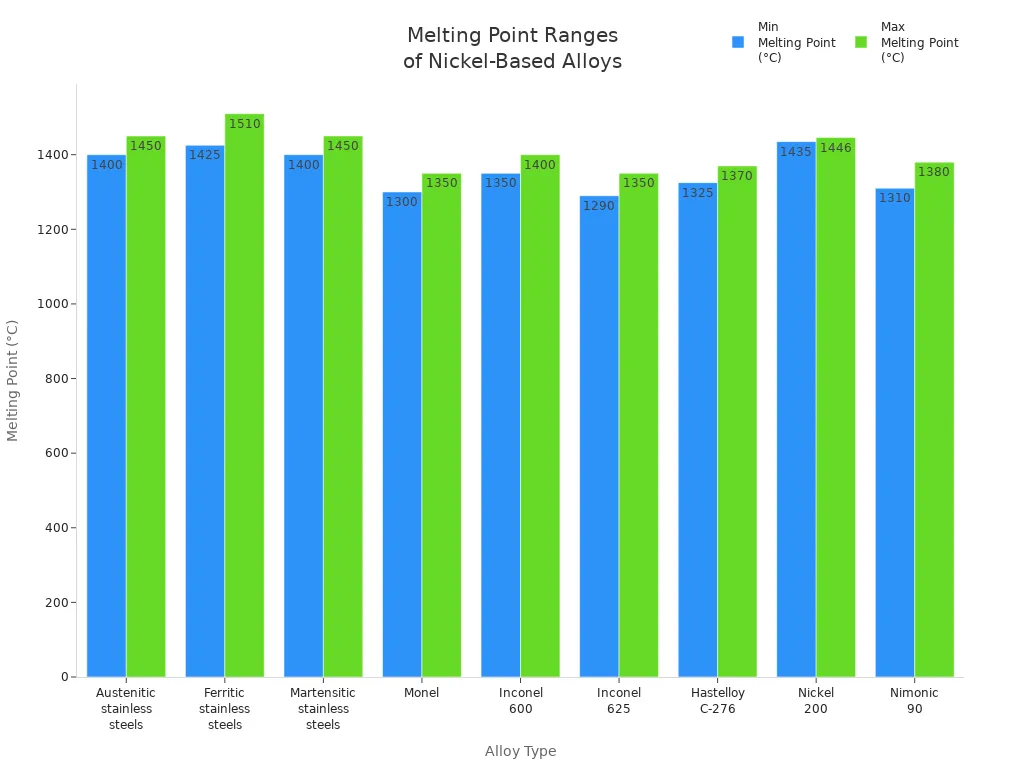
You need melting points to choose alloys for hot jobs.
Microstructure is how grains and phases look inside metal. You see microstructure with a microscope. Small, even grains make metal strong and tough. Big grains can start cracks and make metal weaker. Lots of inclusions can cause metal to fail early. Checking microstructure helps control metal quality.
| Microstructural Feature | Effect on Mechanical Properties |
|---|---|
| Fine, uniform grains | Enhance strength and toughness |
| Coarse grains | Act as crack initiation sites, reducing durability |
| High inclusion content | Leads to premature failure under cyclic loading or corrosive environments |
Malleability means you can hammer or roll metal into thin sheets. Gold and copper are very malleable. Nickel alloys from Bozhong also bend and shape well. You can use them for many things.
Monel is a nickel-copper alloy for tough places. Bozhong sells Monel as sheets, bars, and pipes. Monel 400 and Monel K-500 are popular choices. Monel 400 is strong and resists seawater corrosion. Monel K-500 is even stronger because of age-hardening. The table compares their properties:
| Property | Monel 400 | Monel K-500 |
|---|---|---|
| Nickel Content | 60-70% | 60-70% |
| Copper Content | 30-40% | 30-40% |
| Additional Elements | Small amounts of iron, manganese | Aluminum and titanium |
| Tensile Strength | Moderate | Significantly higher due to age-hardening |
| Yield Strength | Moderate | Significantly higher due to age-hardening |
| Corrosion Resistance | Excellent in various environments | Exceptional, especially in seawater and acids |
| Ductility | Good | Good |
Note: Monel works well for marine, chemical, and oil jobs. It stands up to harsh conditions.
Normalizing makes metals stronger and more even. You heat steel or nickel alloys to a certain temperature. Then you let them cool in the air. This helps the grains inside become the same size. Normalizing gives metals better strength and toughness. It is used for parts that need to be strong and resist corrosion.
Non-ferrous metals do not have iron in them. Aluminum, copper, nickel, and titanium are in this group. These metals do not rust as easily as ferrous metals. You use non-ferrous metals for wires, airplane parts, and chemical tools. Nickel alloys from Bozhong are non-ferrous metals. They are strong and do not corrode easily.
Tip: Pick non-ferrous metals if you want light weight and good resistance to rust.
Oxidation happens when metals touch oxygen. This can make rust or change the color of metal. Some metals, like aluminum and nickel alloys, get a thin layer that protects them. You need to watch for oxidation in hot jobs. Oxidation can make metals weaker over time.
Phases are the different forms metals can have inside. You see phases like austenite, ferrite, and martensite in steel. Each phase changes how strong and rust-resistant the metal is. You can change phases by heating and cooling metals in special ways. Knowing about phases helps you choose the right alloy.
Quenching means cooling hot metals very fast. You dip steel or nickel alloys in water or oil. This makes metals harder and stronger. Quenching also changes the phases inside the metal. You use quenching for tools, gears, and machine parts that must be strong.
Recrystallization happens when you heat worked metals. New grains grow inside and make the metal softer. This helps metals get back strength lost from rolling or forging. You use recrystallization to make metals work better.
Rolling shapes metal by squeezing it between big rollers. This makes sheets, bars, and coils. Rolling makes metals stronger and gives them a smooth surface. Bozhong uses rolling to make nickel alloys with exact sizes and high strength.
| Rolling Type | Description | Common Metals Used | Resulting Strength |
|---|---|---|---|
| Hot Rolling | Done at high heat | Steel, nickel alloys | Good strength, easy to shape |
| Cold Rolling | Done at room heat | Stainless steel, copper | Higher strength, smooth finish |
Slag forms when you melt metals. It is the stuff that floats on top. You take slag away to keep metals clean and strong. Slag also protects hot metal from air and keeps out dirt.
Sintering joins metal powders by heating them but not melting them. You use sintering to make parts with special shapes and high strength. Sintered metals often do not rust easily. You find sintered parts in electronics, engines, and tools.
Tempering makes steel and alloys less brittle and more tough. You heat metal to a set temperature, then let it cool slowly. This process helps you get the right balance between hardness and flexibility. You use tempering for tools, springs, and machine parts that need to bend without breaking.
Tip: Always temper steel after hardening to avoid cracks.
Tensile strength shows how much force you can pull on metal before it breaks. You measure tensile strength in megapascals (MPa) or pounds per square inch (psi). High tensile strength means metal can handle heavy loads. You need this property for bridges, cables, and airplane parts.
| Material | Tensile Strength (MPa) |
|---|---|
| Mild Steel | 400–550 |
| Inconel Alloy | 700–1100 |
| Aluminum Alloy | 200–400 |
Toughness means metal can absorb energy and resist breaking when hit or bent. You want toughness in parts that face shocks or sudden loads. Tough metals work well in construction, mining, and heavy machinery. You test toughness with impact tests like Charpy or Izod.
Work hardening happens when you bend, roll, or hammer metal. The metal gets harder and stronger as you shape it. You use work hardening to make wires, springs, and metal sheets. Nickel alloys from Bozhong respond well to work hardening, so you get strong and reliable products.
Yield strength tells you when metal starts to bend and not return to its shape. You measure yield strength in MPa or psi. High yield strength means metal can hold its shape under stress. You need this for beams, frames, and support structures.
Inconel is a nickel-chromium alloy that stands up to heat and corrosion. Bozhong offers Inconel in sheets, bars, tubes, and wires. You use Inconel for jet engines, chemical plants, and marine equipment. Inconel 600, 625, and 718 are popular grades. These alloys keep their strength at high temperatures and resist rust in harsh environments.
| Grade | Main Features | Common Uses |
|---|---|---|
| Inconel 600 | Good heat resistance | Furnace parts, heaters |
| Inconel 625 | High strength, corrosion proof | Chemical, marine, aerospace |
| Inconel 718 | Excellent mechanical strength | Jet engines, turbines |
Note: Inconel alloys from Bozhong meet ASTM standards and work well in tough jobs. You can trust these alloys for demanding metallurgy applications.

It is important to know mechanical properties when picking metals. Tensile strength tells how much force a metal can take before breaking. Yield strength shows when metal bends and does not go back to its shape. Hardness means how well metal resists scratches or dents. Ductility lets you stretch metal into wires without breaking it. These properties help you choose strong alloys for bridges, machines, and tools. You will see these words often in metallurgical terminology.
Physical properties show how metals act in different jobs. Density tells how heavy metal is for its size. Melting point shows when metal turns into liquid. Thermal expansion means how much metal grows when it gets hot. You need to know these facts for welding, casting, and heat treatment. Nickel alloys have high melting points, so they work well in hot places.
Chemical properties help protect metal from damage. Corrosion resistance stops rust and keeps metal strong in wet or salty places. Oxidation resistance helps metal stay strong when exposed to air or heat. Nickel alloys from Bozhong resist corrosion and oxidation, so you can use them in chemical plants and marine jobs. These properties are important in metallurgical terminology.
You must follow standards to make sure metals are safe and strong. ASTM, GB, DIN, JIS, and ISO set rules for testing and quality. ISO 17025 helps labs give good testing results. If you see ASTM E23 or ISO 148-1, the metal passed tough impact tests. ASTM A370 covers tensile and impact tests. These standards help you trust your products are strong and safe.
Testing checks if metal meets the rules. Non-destructive testing (NDT) finds flaws without hurting the metal. You use eddy current, dye penetrant, magnetic particle, radiographic, ultrasonic, and visual inspection. PMI checks what the metal is made of. Hardness and tensile tests show how strong and tough metal is. Hydrostatic testing checks pipes for leaks. Dimensional testing makes sure sizes are correct.
| NDT Method | Best For | Common Applications | Advantages | Disadvantages |
|---|---|---|---|---|
| Eddy Current Testing | Conductive materials | Aircraft, pipes, welds | Sensitive, fast | Limited depth, surface effects |
| Dye Penetrant Inspection | Surface cracks | Castings, welds, shafts | Finds fine cracks, low cost | Only surface flaws, messy |
| Magnetic Particle Inspection | Ferromagnetic materials | Engine parts, tanks | Real-time, complex shapes | Only ferromagnetic, cleaning |
| Positive Material ID | Metal composition | Alloy checks | Accurate, prevents mix-ups | Only metals, some limits |
| Radiographic Testing | Internal flaws | Welds, tanks | Deep inspection, permanent record | Radiation risk, costly |
| Ultrasonic Testing | Internal flaws | Welds, thickness checks | Immediate results, safe | Needs skill, smooth surface |
| Visual Inspection | Surface flaws | Welds, maintenance | Quick, no equipment | Only surface, human error |
Tolerance means how close metal’s size is to what you want. Precision helps you get the exact shape and size. You need tight tolerance for parts that fit together, like gears or engine pieces. Good tolerance and precision make products safer and stronger. You see these words often in metallurgical terminology, especially when you order custom alloys from Bozhong.
Tip: Always check testing results and certifications before using metals in important jobs. This keeps your project safe and reliable.
You can make this glossary even better.
Share new metallurgy words or ask questions in the comments.
Your ideas help keep this guide helpful for all.
Bozhong gives you trusted nickel alloy help and expert tips. You always get good products and clear facts. Visit Bozhong Alloy to learn more.
Nickel-based alloys have many good features. They are strong and do not rust easily. They can handle high heat. These features are useful in planes, ships, and chemical plants. Knowing these features helps you pick the right alloy for your work.
You test stainless steel to see if it is good. You check how hard and strong it is. You see if it resists rust. You look for papers that prove it meets rules. You also check the surface for any problems. Tests help you make sure the steel is good.
Properties show how stainless alloys will work. You check if they are tough and bend without breaking. You see if they resist rust. These things help you know if the alloy is right for you. You want the best properties for safety and good results.
Martensitic stainless steel is different from other types. It is very hard and strong. People use it to make tools and knives. Its special crystal shape gives it these features. This steel is trusted for jobs that need strong and sharp parts.
You watch the features during making. You test the steel many times. You use only approved materials. You follow strict rules for making it. You check everything before sending it out. This makes sure the steel is good for your needs.
Tip: Always check the features and quality before using stainless alloys for important work.
You can ask more questions about features or quality in the comments. - Your ideas help make the stainless glossary better.
| Stainless Alloy Type | Key Properties | Common Uses | Quality Check |
|---|---|---|---|
| Austenitic | Toughness, corrosion resistance | Food tools, pipes | Surface, strength |
| Ferritic | Magnetic, rust resistance | Car parts, appliances | Hardness, finish |
| Martensitic | Hardness, strength | Blades, valves | Tensile, microstructure |


