
English 
Room501, Building32, No. 518 Xinzhuan Highway, Songjiang District, Shanghai, China 201612
Views: 0 Author: Site Editor Publish Time: 2026-10-22 Origin: Site


Specifying superalloys for extreme environments carries massive stakes. Select the wrong material, and you face catastrophic mechanical failure under heavy mechanical loads. Over-specify the material, and project resources inflate unnecessarily. Engineers frequently struggle to balance extreme thermal and corrosive resistance requirements against the high raw material demands of high-nickel alloys. Both Inconel and Incoloy are registered trademarks of Special Metals Corporation. They represent distinct families of high-performance superalloys. Each family targets different tiers of environmental severity. This technical evaluation guide definitively differentiates the Inconel and Incoloy families. We compare their chemical compositions, performance thresholds, and specific grade-to-grade trade-offs. You will gain the exact data needed to make a precise, highly effective material selection for your next critical engineering project.
Compositional Baseline: Inconel is a nickel-chromium alloy (typically >50% nickel), whereas Incoloy is a nickel-iron-chromium alloy (typically <50% nickel, with higher iron content).
Performance Thresholds: Inconel generally withstands higher maximum service temperatures (up to 2000°F) and more aggressive corrosive environments compared to Incoloy (often capped around 1800°F).
Cost vs. Capability Trade-off: Incoloy serves as a highly capable, cost-effective alternative to Inconel for moderate-to-high temperature and corrosive applications, preventing budget waste from over-specification.
Application Specificity: Material selection must be driven by exact grade comparisons (e.g., Inconel 625 vs Incoloy 825) rather than broad family characteristics, factoring in specific localized corrosion risks like sour gas or chloride stress corrosion cracking.
Table of Contents
Inconel and Incoloy alloys differ mainly in their nickel, iron, and chromium content. These differences influence high-temperature strength, oxidation resistance, corrosion resistance, and material cost. Understanding their composition helps engineers select the right alloy for demanding industrial applications.
Inconel alloys generally contain high levels of nickel and chromium, providing good oxidation resistance and mechanical stability at elevated temperatures. Different grades offer additional benefits, including corrosion resistance or precipitation-hardening capability. For example, Inconel 600 Alloy is commonly used in chemical processing and industrial heating equipment.
Incoloy alloys typically combine nickel, iron, and chromium to balance corrosion resistance, high-temperature performance, and material cost. They are widely used in heat exchangers, industrial furnaces, and chemical processing equipment. Explore our Incoloy Alloy range for available grades and product forms.
Alloying elements help improve specific material properties. Chromium supports oxidation resistance, molybdenum improves resistance to certain localized corrosion conditions, and aluminum or titanium can contribute to precipitation strengthening in suitable grades. Copper also improves resistance to selected acidic environments, depending on the alloy composition.
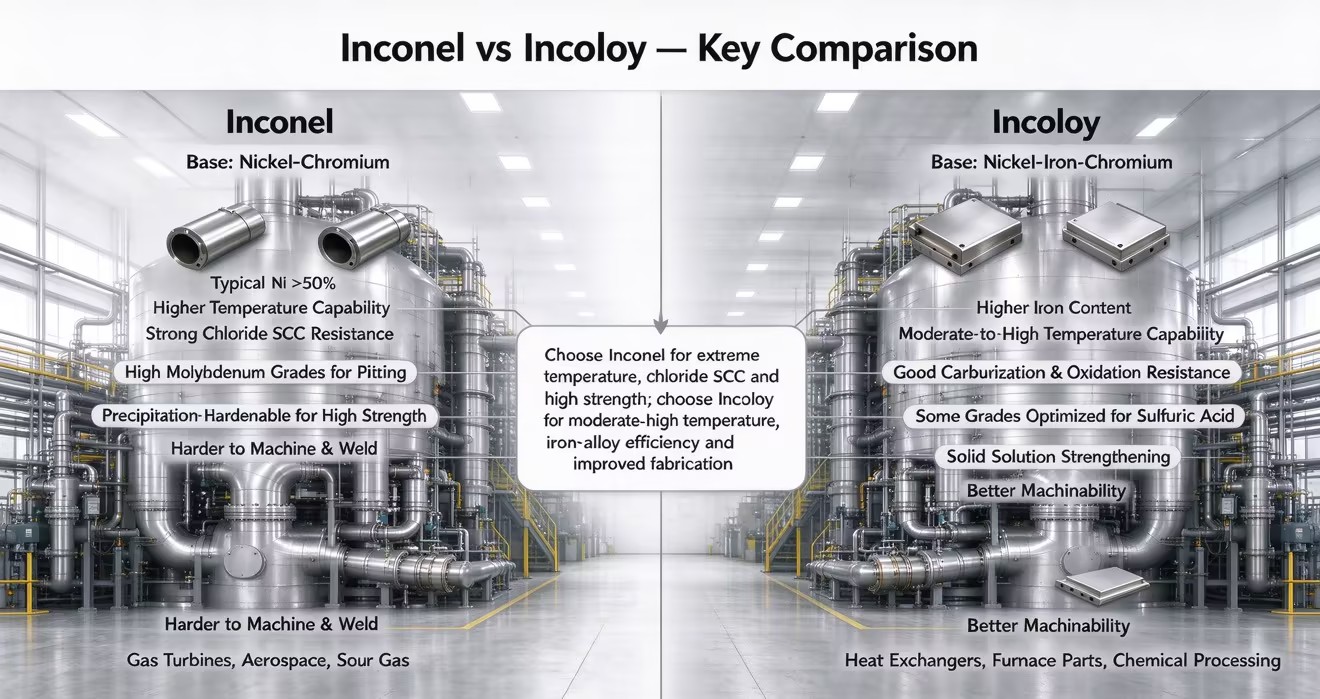
Inconel vs. Incoloy performance depends on the individual grade, operating temperature, chemical environment, mechanical load, and manufacturing requirements.
High-temperature performance varies significantly between grades. Inconel alloys are widely used in demanding thermal applications, while Incoloy grades such as 800H and 800HT are designed for elevated-temperature service. The allowable operating temperature depends on stress, exposure time, and environmental conditions rather than alloy family alone. Explore our Incoloy 800H Alloy for high-temperature applications.
Corrosion resistance depends on alloy chemistry and the surrounding environment. Grades containing molybdenum often provide improved resistance to pitting and crevice corrosion, while selected nickel-iron-chromium alloys are suitable for chemical processing applications. For marine and aggressive industrial environments, our Inconel 625 Alloy offers a relevant material option.
Mechanical strength varies with alloy composition and heat treatment. Precipitation-hardened grades can provide high yield strength and fatigue resistance for demanding structural applications, while other grades focus on corrosion resistance and ductility. Our Inconel 718 Alloy is commonly selected for aerospace, turbine, and high-stress components.
Nickel alloy fabrication requires consideration of work hardening, tool wear, and welding procedures. Machinability and weldability depend on the specific alloy grade, material condition, and manufacturing process. Selecting appropriate cutting tools, welding consumables, and processing parameters helps improve production efficiency.
Forming and heat treatment requirements vary between Inconel and Incoloy grades. Some alloys require intermediate annealing during extensive cold forming, while precipitation-hardened materials may need controlled heat treatment to achieve specified properties. Welding and post-weld treatment should follow the applicable material specifications and fabrication standards.
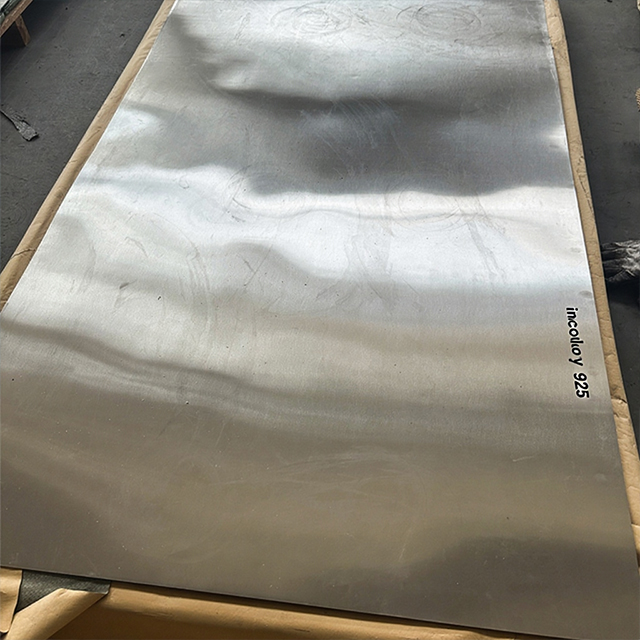
Inconel and Incoloy alloys differ in chemical composition, high-temperature performance, corrosion resistance, and mechanical strength. Comparing individual grades helps engineers select suitable materials for their operating conditions.
Alloy Grade | Main Advantage | Typical Applications |
|---|---|---|
Inconel 600 | Oxidation and chloride stress-corrosion cracking resistance | Chemical processing, furnace components |
Incoloy 800 | High-temperature oxidation and carburization resistance | Heat exchangers, industrial furnaces |
Inconel 625 | Pitting and crevice corrosion resistance | Marine, offshore, chemical processing |
Incoloy 825 | Resistance to selected acidic and chloride-containing environments | Acid processing, oil and gas |
Inconel 718 | High strength through precipitation hardening | Aerospace, gas turbines, high-stress components |
Note: Maximum service temperature depends on loading, exposure time, atmosphere, and material condition. A single temperature rating should not be applied to every application.
Inconel 600 is a nickel-chromium alloy valued for oxidation resistance and resistance to chloride stress-corrosion cracking in suitable environments. Incoloy 800 contains more iron and is commonly selected for high-temperature equipment requiring oxidation and carburization resistance. Explore our Inconel 600 Alloy and Incoloy 800 Alloy products for available material forms and specifications.
Inconel 625 offers strong resistance to pitting, crevice corrosion, and many aggressive marine environments. Incoloy 825 contains molybdenum and copper to improve resistance to selected acids and corrosive process fluids. The better choice depends on chemical concentration, temperature, and exposure conditions. View our Inconel 625 Alloy and Incoloy 825 Alloy products for technical specifications.
Inconel 718 is a precipitation-hardenable alloy designed for applications requiring high strength and fatigue resistance. Incoloy 825 focuses on corrosion resistance in selected chemical environments. Choose 718 when mechanical strength is the main requirement and consider 825 when resistance to process-fluid corrosion is more important. Explore our Inconel 718 Alloy for available specifications.
Nickel alloy selection should consider more than the initial material price. Operating conditions, fabrication costs, maintenance, and expected service life all influence long-term value.
Selecting a more expensive alloy does not always improve project performance. Engineers should match corrosion resistance, operating temperature, and mechanical strength to actual requirements rather than choosing the highest alloy grade by default.
Lifecycle cost includes raw material, machining, welding, maintenance, and replacement expenses. A more suitable alloy may reduce fabrication costs while still providing the required durability.
Incorrect nickel alloy selection may lead to corrosion, premature component failure, fabrication problems, or increased project costs.
An alloy with insufficient corrosion resistance or high-temperature strength may fail under demanding operating conditions. Before selecting a grade, confirm maximum service temperature, chemical exposure, pressure, and mechanical loads. Refer to the applicable material standards and corrosion data.
Nickel-based alloys may require specialized machining tools, welding procedures, and heat treatment controls. Work-hardening behavior and material strength can affect production efficiency. Involving fabrication teams early helps reduce manufacturing delays and unexpected costs.
Potential Risk | Main Cause | Recommended Action |
|---|---|---|
Corrosion Failure | Unsuitable alloy for the chemical environment | Verify corrosion resistance |
Thermal Damage | Operating conditions exceed material capability | Check temperature and mechanical loads |
High Material Cost | Unnecessary high-alloy specification | Compare suitable alternatives |
Machining Difficulties | Work hardening and tool wear | Plan tooling and machining parameters |
Welding Problems | Inappropriate welding procedures | Verify filler metal and welding requirements |
The choice between these two superalloy families is fundamentally a calculation of nickel content versus iron content. This ratio dictates the boundary between extreme environmental survival and efficient, targeted performance. High-nickel alloys provide the ultimate defense against extreme temperatures and aggressive localized corrosion. Iron-integrated alloys provide robust, highly capable performance for moderate-to-severe environments while improving machinability.
Use clear shortlisting logic for your projects. Choose the high-nickel family for aerospace components, extreme high-temperature applications exceeding 1800°F, and severe sour gas environments. Choose the iron-integrated family for chemical processing, industrial heating elements, and moderate high-temperature environments where machinability and targeted acid resistance are priorities.
Consult with a certified metallurgical engineer to review your exact environmental operating parameters and temperature spikes.
Request a detailed Material Test Report (MTR) from your supplier to verify the exact chemical composition of the proposed grade.
Conduct a localized corrosion test using a sample coupon in your actual process fluid before full-scale implementation.
Review the machining and welding procedures with your fabrication team to ensure they have the correct tooling and filler metals.
A: No. They are distinct families of high-performance superalloys produced by Special Metals Corporation. They are differentiated primarily by their base metal ratios. Inconel is a nickel-chromium alloy with high nickel content. The other family is a nickel-iron-chromium alloy that substitutes a significant portion of nickel with iron.
A: The specific breakdown includes 38-46% Nickel, a 22% minimum Iron content, and 19.5-23.5% Chromium. It also features targeted additions of Molybdenum (2.5-3.5%), Copper (1.5-3.0%), and Titanium. The titanium addition specifically stabilizes the alloy against sensitization and intergranular corrosion during welding.
A: Yes, dissimilar metal welding is entirely possible. You must use specific filler metals, typically a high-nickel filler matching the higher-alloyed base metal. This process requires strict adherence to pre-weld cleaning and post-weld cooling procedures to prevent solidification cracking in the weld zone.
A: Grade 800 is typically rated for prolonged service up to 1500°F to 1800°F. Specific variants, such as 800H or 800HT, feature controlled carbon, aluminum, and titanium levels. These specific variants are optimized for higher creep and rupture resistance at the upper end of this temperature range.
A: Base your choice on exact operating temperatures and chemical exposures. If your process exceeds 1800°F or involves severe chlorides and sour gas, specify the high-nickel option. If your process operates below 1800°F, involves sulfuric acid, or requires extensive machining, the iron-integrated option is usually the better engineering choice.
A: It depends on the environment. While high iron content reduces resistance to severe chloride stress-corrosion cracking compared to pure nickel alloys, it performs exceptionally well in many industrial environments. Specific iron-rich grades with copper additions actually outperform high-nickel grades in reducing acids like sulfuric acid.


