
English 
Room501, Building32, No. 518 Xinzhuan Highway, Songjiang District, Shanghai, China 201612
Views: 0 Author: Site Editor Publish Time: 2026-01-08 Origin: Site



You see monel as a strong nickel-copper alloy with special features. The main part of monel has a lot of nickel and copper. This makes it hard and helps it fight rust.
| Element | Percentage |
|---|---|
| Nickel | 63-70% |
| Copper | 20-29% |
Monel is great because it can handle seawater, strong chemicals, and tough places. You should know what is in monel because it affects how it works in boats, planes, and factories. Bozhong gives ASTM-certified monel products with the right amount of nickel. This means you get good quality you can trust. Learn more in All About Monel Alloys: Definition.
Monel alloy is a tough nickel-copper mix. It has about 63-70% nickel and 20-29% copper. This makes it hard for Monel to rust or get damaged by water.
Monel alloys work well in tough places. They are used in the ocean and in chemical plants. They can handle seawater and strong acids without breaking down.
There are different types of Monel, like Monel 400 and K-500. Each type has its own good points. K-500 is stronger and good for heavy jobs.
Bozhong sells top-quality Monel alloys. These alloys follow ASTM rules. This means they are safe and work well for many jobs in factories.
If you pick Monel for your work, you get a strong material. It does not need much care and works great in very hard conditions.
Monel alloys are special because they are made from nickel and copper. These alloys are used where strength and corrosion resistance are important. Monel has between 52% and 68% nickel. The rest is mostly copper, with a little iron, manganese, carbon, and silicon. This mix gives monel its solid structure. Monel alloys have only one phase. You can shape monel by heating, cooling, cutting, or welding. The table below shows the main properties of monel as listed by materials groups:
| Property | Description |
|---|---|
| Composition | Nickel (52-68%) and copper, with small amounts of iron, manganese, carbon, and silicon. |
| Corrosion Resistance | Resistant to corrosion by many aggressive agents, including rapidly flowing seawater. |
| Fabrication | Can be fabricated by hot- and cold-working, machining, and welding. |
| Alloy Type | A solid-solution binary alloy, single-phase due to mutual solubility of nickel and copper. |
| Machinability | Difficult to machine as it work-hardens quickly; requires slow speeds and low feed rates. |
| Applications | Commonly used in highly corrosive conditions and can withstand fire in pure oxygen. |
Monel does not rust in seawater. It is better than many other metals at fighting corrosion. You see monel used in ships, chemical plants, and oil and gas work. Monel stays strong in both hot and cold places. You can use monel where other metals break.
Bozhong sells high-quality monel alloys. Their products meet ASTM standards. Bozhong has made monel alloys for over 20 years. You can buy plates, bars, pipes, wires, and custom parts. Their team uses advanced tools to make sure you get good monel alloys.
Tip: If you need materials for tough places, monel alloys are a good choice. Monel alloys last a long time and need little care.
Monel alloys are special because they fight seawater corrosion very well. They also resist acids like hydrofluoric and sulfuric acids. Monel alloys work in alkaline solutions without getting damaged. This makes them different from other nickel alloys.
Monel alloys are strong and have good physical properties. Here are some key features:
Monel alloys stay strong at high temperatures.
Monel alloys keep their strength at low temperatures.
Density: 8400
Young’s Modulus: 1.8
Hardness: 65 Rockwell B (Monel 400)
Monel K-500 is even stronger and harder, great for marine and oil jobs.
Thermal Conductivity: 21.8 W/m·K
Specific Heat: 427 J/kg·K
Monel alloys move heat well, so they are good for heat exchangers.
Monel alloys do well in real tests. Studies show monel alloys have high corrosion resistance. They keep their value even after days in harsh places. Monel alloys get better at fighting wear after special treatments.
Bozhong is a trusted seller of monel alloys. Their products meet world standards. The table below shows Bozhong’s certifications:
| Certification | Description |
|---|---|
| ISO 9001 | International standard for quality management systems |
| ASME | American Society of Mechanical Engineers standards |
| ASTM | American Society for Testing and Materials standards |
You can count on Bozhong for monel alloys that fit your needs. Bozhong offers custom options and quick delivery. Their monel alloys work well in marine, chemical, and industrial jobs.
Learning about monel alloys helps you see why monel is good for hard work. Monel alloys give you strength, durability, and corrosion resistance. You can trust Bozhong to give you monel alloys that keep your systems working.
Monel is a nickel alloy that does not rust easily. Its chemical makeup gives it special qualities for tough jobs. Nickel and copper are the main parts of monel. These two metals help monel fight rust and stay strong. There are also small amounts of iron, manganese, silicon, sulfur, aluminum, and titanium in some types.
Here is a table showing the main elements in different types of monel:
| Element | Monel 400 | Monel R-405 | Monel K-500 |
|---|---|---|---|
| Nickel (wt %) | 63 min. | 63 min. | 63 min. |
| Copper (wt %) | 28 - 34 | 28 - 34 | 27 - 33 |
| Manganese (wt %) | 2 max. | 2 max. | 1.5 max. |
| Iron (wt %) | 2.5 max. | 2.5 max. | 2 max. |
| Sulfur (wt %) | 0.024 max. | 0.025 to 0.060 | 0.01 max. |
| Silicon (wt %) | 0.5 max. | 0.5 max. | 0.5 max. |
| Aluminum (wt %) | 0 | 0 | 2.3 to 3.15 |
| Titanium (wt %) | 0 | 0 | 0.35 to 0.85 |
Nickel is the biggest part of monel. Copper is the next most common. Iron and manganese help keep monel tough and strong. Monel K-500 has aluminum and titanium. These make it harder and stronger.
The chemical makeup of monel can change a little by grade. Most monel alloys have between 63% and 70% nickel. Copper is usually between 27% and 34%. The other elements are only in small amounts.
Here is a table with typical composition percentages for two popular grades:
| Element | Monel 400 (%) | Monel K-500 (%) |
|---|---|---|
| Nickel | 63%–70% | 63% (min) |
| Copper | 30%–33% | 27%–33% |
| Aluminum | N/A | 2.3%–3.15% |
| Iron | Small amounts | N/A |
| Manganese | Small amounts | N/A |
| Carbon | Small amounts | N/A |
| Silicon | Small amounts | N/A |
Monel K-500 has more aluminum and titanium. These make it harder and better for tough jobs. Monel 400 is simpler. It is easy to bend and stays tough.
Bozhong checks the makeup of every monel alloy they make. You get ASTM-certified monel with the right amounts. Bozhong follows rules like ASTM B127, ASTM B164, and ASTM B366. These rules make sure you get monel with the right chemical makeup for your needs.
| ASTM Standard | Description |
|---|---|
| ASTM B127 | Governs Monel 400 Plate, Sheet, and Strip |
| ASTM B164 | Covers rod, bar, and wire forms of Monel 400 |
| ASTM B564 | Addresses forgings of Monel 400 |
| ASTM B366 | Specifies factory-made fittings for Monel 400 |
The chemical makeup of monel changes how it acts and works. Nickel helps monel fight rust. Copper makes monel tough and bendy. Iron and manganese keep monel strong. Aluminum and titanium make Monel K-500 harder and good for heavy work.
Monel makes a thin film when it touches seawater. This film heals itself if scratched. That helps monel keep fighting rust. Monel has a single-phase structure. This stops attacks between grains. If iron is controlled, it stops small spots of rust. Monel lasts a long time in salty or chemical places.
Here is a table showing how each element helps monel resist corrosion:
| Element | Composition (%) | Role in Corrosion Resistance |
|---|---|---|
| Nickel | ≥63 | Gives great resistance to rust and keeps monel stable. |
| Copper | 28-34 | Helps monel stay stable and bendy. |
| Iron | ≤2.5 | Too much iron can cause rust, so it is kept low. |
Monel makes a self-healing film in seawater.
The single-phase structure stops grain attacks.
Low iron helps stop small rust spots.
Monel works well in saltwater, acids, and harsh chemicals. Its makeup makes it a top pick for ships, offshore gear, and chemical plants. Monel stays strong in hot and cold places. Its strength and toughness do not change much over time.
Bozhong uses smart ways to control the makeup of every monel alloy. You get monel that meets strict ASTM rules. You can trust Bozhong to give you monel with the right chemical makeup for your project.
Tip: If you need a material that fights rust and stays strong in seawater, monel is a smart pick. Bozhong can help you choose the right monel alloy for your job.
You will find that monel 400 and monel k-500 are the most common grades. Monel 400 is a solid solution alloy. It contains about 63% nickel and 28–34% copper. Monel k-500 builds on monel 400 by adding aluminum and titanium. These extra elements make monel k-500 stronger and harder. You can see the main differences in the table below:
| Alloy | Nickel Content | Copper Content | Aluminum Content | Titanium Content | Sulfur Content | Manganese Content |
|---|---|---|---|---|---|---|
| Monel 400 | ~63% | ~28–34% | N/A | N/A | < 0.024% | Max 2.00% |
| Monel K-500 | ~63% | ~27–33% | 2.3–3.15% | 0.35–0.85% | < 0.010% | Max 1.50% |
Monel 400 gives you great corrosion resistance and good strength. Monel k-500 gives you even higher strength and toughness. You can use monel 400 for valves, pumps, and marine equipment. Monel k-500 works well in oil extraction and aerospace parts.
You can choose from different grades of monel alloys for special jobs. Monel r-405 is like monel 400 but has more sulfur. This makes monel r-405 easier to machine. You will see monel r-405 in parts that need lots of cutting or shaping. Here is a table showing some grades and their main uses:
| Grade | Primary Applications |
|---|---|
| Monel 400 | Marine and chemical environments, valves, pumps, and equipment exposed to corrosive chemicals. |
| Monel R-405 | Improved machinability, used in similar applications as monel 400. |
| Monel K-500 | Enhanced mechanical strength, used in oil extraction and aerospace components. |
You can use monel 400 and monel r-405 in the marine industry, chemical processing, and oil and gas. Monel k-500 is best for high-stress jobs.
You will notice that different grades of monel alloys have small changes in their makeup. Monel 400 has a simple mix of nickel and copper. Monel k-500 adds aluminum and titanium for more strength. Monel r-405 has more sulfur for better machinability. These changes affect how you use each grade.
Monel 400 gives you about 550 MPa tensile strength and 40–50% elongation. Monel k-500, after aging, gives you even higher strength but less elongation. You can see that monel k-500 is better for heavy-duty parts. Monel r-405 is best when you need to machine parts quickly.
Tip: If you need high performance monel alloys for tough jobs, choose the grade that matches your needs.
You will also see that monel costs more than stainless steel. This is because monel has more nickel and gives you better corrosion resistance. The chart below shows how monel compares to other alloys:
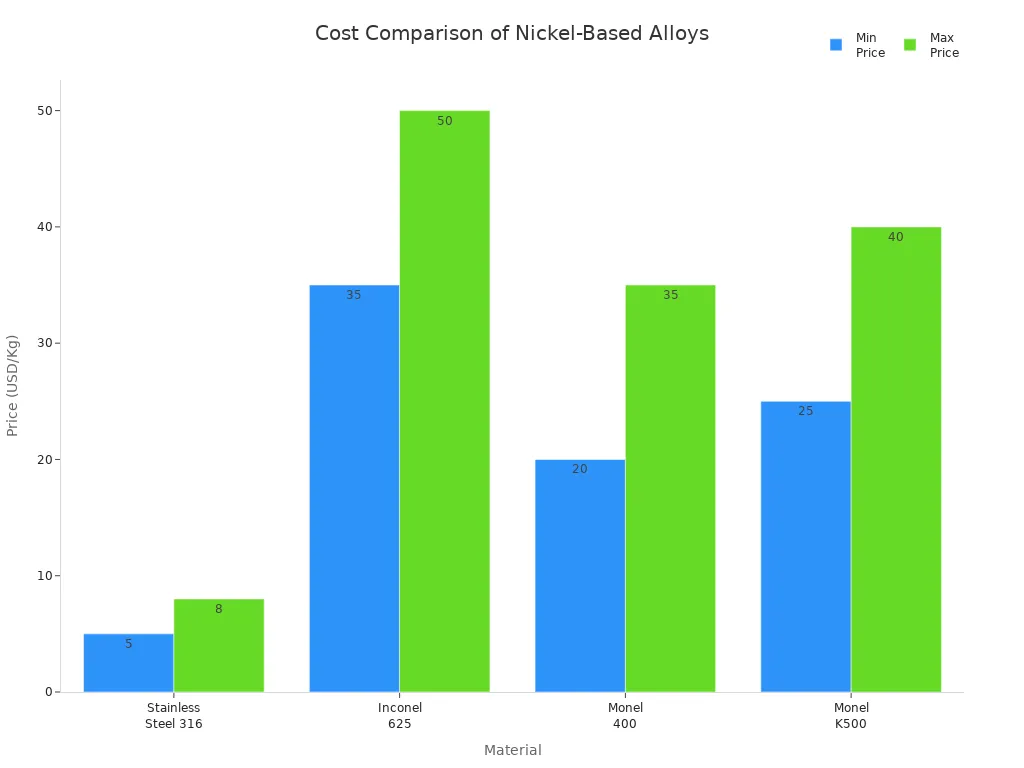
You can trust monel for marine, chemical, and oil and gas work. Each grade gives you special benefits for your project.
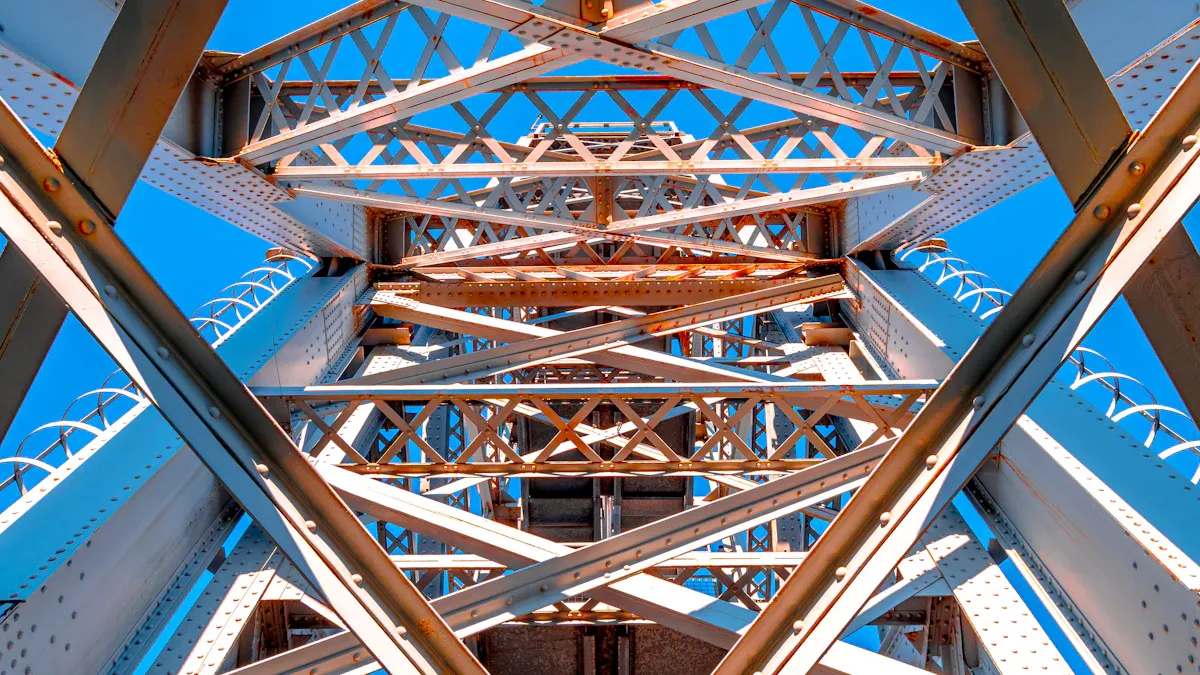
Monel is used a lot in marine jobs. It does not get damaged by seawater or tough weather. This alloy works well where other metals do not last. Some common uses for monel in the sea are:
Offshore platforms and marine engineering
Shipbuilding
Seawater handling equipment
Monel protects against rust from saltwater. It also stands up to acids and bases. You can use monel for pumps, valves, and pipes on ships and oil rigs. Monel alloys like Monel 400 and Monel K-500 last many years in the ocean. They do not rust or fall apart, even after a long time. Monel also stops sea life from sticking to it. This means less cleaning and better performance for marine jobs.
Monel is good for many factory and chemical jobs. You can use monel fasteners in chemical plants because they do not rust in strong acids. For example, monel fasteners replaced regular ones in a sulfuric acid plant. The new fasteners lasted longer and needed less fixing. Monel stands up to sulfuric and hydrochloric acids. It can handle heat up to 1000°F (538°C). You will see monel in oil work, power plants, and chemical factories. Monel does not rust in brine, hydrofluoric acid, or alkaline solutions. This makes it a smart pick for hard jobs where other metals fail.
You should pick Bozhong for your monel needs. They give you good quality, custom choices, and worldwide supply. Bozhong sells ASTM-certified monel in many shapes, like coil, sheet, plate, rod, bar, tube, pipe, and wire. You can get special sizes and finishes for your project.
| Customization Options | Description |
|---|---|
| Custom Sizes | Tailored dimensions to meet specific requirements |
| Surface Finishes | Various finishes to suit industry needs |
Bozhong helps many industries, such as marine, chemical, oil and gas, and power plants. Their worldwide supply chain lets you get monel fast, wherever you are.
| Product Forms | Services Offered | Industries Served |
|---|---|---|
| Coil, Sheet, Plate, Rod, Bar, Tube, Pipe, Beam, Angle, Flange, Wire, Strip, Channel | Oxygen cutting, Plasma cutting, Laser cutting, Ultrasonic testing | Automobile, Railway, Aviation, Aerospace, Machinery, Petrochemical, Energy, Environmental Protection, Offshore, Chemical, Oil & Gas, Military, Power Plant, Nuclear Power, Pressure Vessel, Boiler Equipment, Mold Manufacture |
You can trust Bozhong to give you monel that fits your needs. Monel alloys last a long time, need little care, and fight rust well. Bozhong helps you do well in all your jobs.
Monel alloy is a strong material. It is made mostly of nickel and copper. The table below shows the main elements in Monel:
| Element | Percentage |
|---|---|
| Nickel | ~66% |
| Copper | ~30% |
| Iron | Minimal |
| Manganese | Minimal |
This mix helps Monel fight rust. It also keeps Monel tough in hard places. You can use Monel for marine, chemical, and energy jobs. Monel stays strong and lasts a long time. Bozhong sells Monel that meets strict rules. If you need something strong for hard work, pick Monel alloy from Bozhong.
Monel Alloy is used in ships and factories. It works well in places with seawater or strong chemicals. You can trust it for pumps and valves. It is also good for heat exchangers.
No, Monel Alloy does not rust in seawater. Its nickel-copper mix makes a shield. This shield keeps the metal safe from damage. It works even in salty or moving water.
Yes, you can weld Monel Alloy. You can use TIG or MIG welding. Make sure to use the right filler. Control the heat for good results.
Monel Alloy fights seawater and chloride better than most stainless steels. It stays strong in tough places. Pick Monel when you need extra strength.
Monel Alloy is usually not magnetic. You can use it in electrical jobs. It is also good for marine work where low magnetism is needed.


