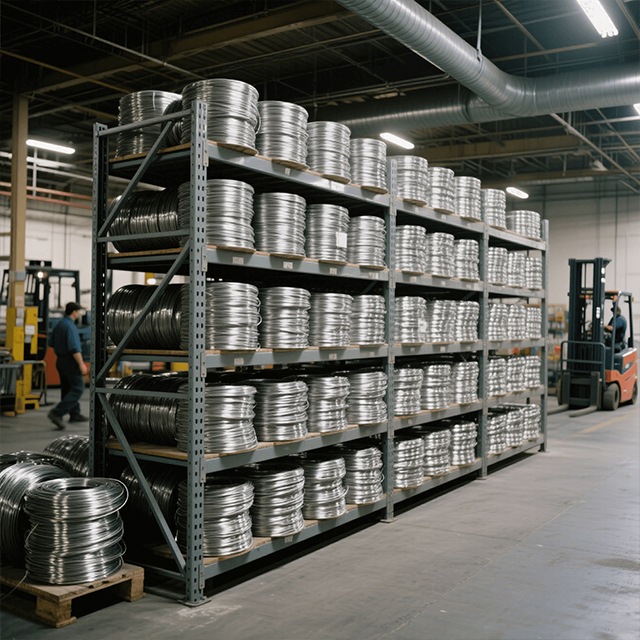
Incoloy A286 Product Introduction
International Grade Comparison
Standard System | Grade | Description |
ASTM (USA) | S66286 | UNS Unified Numbering System Grade (exclusive for Incoloy A286) |
EN (EU) | X5NiCrTi26-15 | EN 10088-1 Standard Grade (precipitation-hardening type) |
JIS (Japan) | SUS660 | JIS G4303/J4902 Standard Grade (equivalent to A286) |
DIN (Germany) | 1.4980 | DIN 17750 Standard Grade (iron-nickel-chromium precipitation alloy) |
ISO (International) | FeNi26Cr15Ti | ISO 6363 Standard Grade (medium-high temp precipitation-hardened variant) |
Physical Properties (Room Temperature & High-Temperature Highlights)
Property Indicator | Typical Value (Room Temp, After Precipitation Hardening) | Unit | High-Temperature Advantage |
Tensile Strength | ≥965 | MPa | 704°C creep rupture strength: ≥172 MPa (1,000 hours) |
Yield Strength (0.2% Offset) | ≥690 | MPa | 704°C short-term tensile strength: ≥550 MPa |
Elongation (50mm Gauge Length) | ≥15 | % | Retains ≥10% elongation at 650°C |
Density | 7.9 | g/cm³ | Lower than nickel-based alloys (e.g., Incoloy 800: 8.0 g/cm³) |
Melting Point | 1360-1410 | ℃ | Stable up to maximum service temperature (704°C) |
Chemical Composition (Mass Fraction, Key Elements with Hardening Mechanism)
Chemical Symbol | Composition Range (%) | Role in Performance |
Fe | Balance | Matrix base; reduces cost vs. nickel-based alloys |
Ni | 24.0-27.0 | Enables γ' phase (Ni₃(Ti,Al)) formation; stabilizes austenite |
Cr | 13.5-16.0 | Forms Cr₂O₃ oxide film for high-temp oxidation resistance |
Ti | 1.9-2.35 | Primary precipitation hardener (key component of γ' phase) |
Al | 0.1-0.5 | Co-precipitation with Ti to refine γ' phase; enhances strength |
Mo | 1.0-1.5 | Improves high-temperature creep resistance and solid-solution strengthening |
V | 0.1-0.5 | Refines grain size; inhibits grain growth at high temps |
C | ≤0.08 | Controls carbide formation; avoids brittle intergranular phases |
Si/Mn | ≤1.0/≤2.0 | Improves hot workability; minimizes cracking during forging |
P/S | ≤0.03/≤0.015 | Reduces impurity-induced brittleness |
Product Characteristics
1. Precipitation-Hardened High Strength: Nano-scale γ' phase (Ni₃(Ti,Al)) formed via heat treatment (e.g., 704°C aging) delivers ≥965 MPa room-temperature tensile strength—30% higher than Incoloy 800—with stable strength up to 704°C;
2. Excellent Creep Resistance: Balanced Mo-V-Ti composition ensures 704°C creep rupture strength of ≥172 MPa (1,000 hours), suitable for long-term load-bearing in medium-high temp environments;
3. Good High-Temp Oxidation Resistance: 13.5-16% Cr content forms a dense, adherent oxide film, resisting scaling in air, flue gas, and weak oxidizing atmospheres up to 704°C;
4. Cost-Effective Alternative: Iron-based matrix reduces material cost by ~20-30% compared to nickel-based Incoloy 800 series, without compromising medium-high temp performance;
5. Versatile Processability: Compatible with hot/cold working (forging, rolling, bending) and welding; post-weld aging restores precipitation hardening—simpler than nickel-based alloy heat treatment.
Metallographic Structure
• As-annealed State: Uniform face-centered cubic (FCC) austenitic matrix with ASTM grain size 5-8 grades; no visible precipitates, ensuring good ductility for processing.
• After Precipitation Hardening: Austenitic matrix with dispersion of nano-scale γ' phase (Ni₃(Ti,Al)) (5-20 nm in size) at grain boundaries and within grains. These precipitates act as "mechanical barriers" to dislocation movement, significantly enhancing strength without inducing brittleness. No harmful intermetallic phases (e.g., sigma phase) form even after long-term exposure to 704°C.
Product Forms and Executive Standards
Product Form | Main International Executive Standards | Application Reference |
Plates/Strips | ASTM A240/A480, EN 10088-2 | High-temperature pressure vessel shells, aircraft engine combustion chambers |
Seamless Pipes/Tubes | ASTM A269/A312, EN 10216-5 | Petrochemical high-temperature fluid pipelines, aerospace fuel ducts |
Bars/Forgings | ASTM A479/A564, EN 10269 | Turbine fasteners, gas turbine blades, pump shafts, valve stems |
Wires | ASTM A580, EN 10250-3 | High-temperature springs, welding filler wires for structural joints |