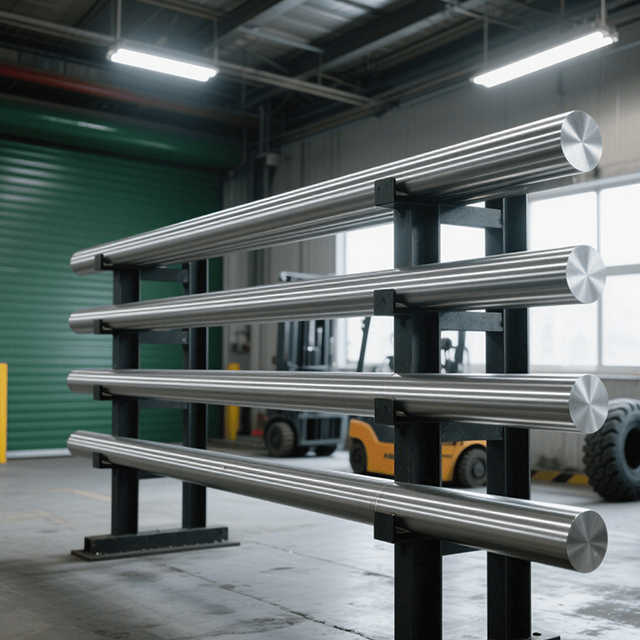
Incoloy 800HT Product Introduction
Product Overview
Incoloy 800HT (HT = High Temperature) is the ultra-high-temperature optimized variant of Incoloy 800H, developed by Special Metals Corporation (USA), engineered exclusively for extreme elevated-temperature scenarios requiring unparalleled creep rupture strength and structural stability. Its core upgrades lie in stricter grain size control (ASTM 4-7 grades, finer than Incoloy 800H’s ASTM 5-8) and precision carbon/titanium ratio tuning, enabling it to maintain reliable performance at temperatures up to 1040°C—surpassing Incoloy 800H’s 980°C limit. The alloy retains 800H’s excellent oxidation/carburization resistance while delivering superior long-term creep life under ultra-high-temperature loads (e.g., 100,000-hour creep rupture at 900°C). Widely used in advanced energy, petrochemical, and nuclear industries, it is the go-to material for components in supercritical environments or continuous 1000°C+ service where Incoloy 800H or other nickel-based alloys fall short.
International Grade Comparison
Standard System | Grade | Description |
ASTM (USA) | N08811 | UNS Unified Numbering System Grade (exclusive for 800HT, distinguishing from 800H’s N08810) |
EN (EU) | NiCr20FeTi | EN 10088-1 Standard Grade (ultra-high-temperature specification) |
JIS (Japan) | NW08811 | JIS G4902 Standard Grade (corresponds to 800HT) |
DIN (Germany) | 1.4878 | DIN 17750 Standard Grade (differentiated from 800H’s 1.4877) |
ISO (International) | NiCr20FeTi | ISO 6363 Standard Grade (high-temperature creep-optimized variant) |
Physical Properties (Room Temperature & High-Temperature Highlights)
Property Indicator | Typical Value (Room Temp) | Unit | High-Temperature Advantage |
Tensile Strength | ≥580 | MPa | 980°C creep rupture strength: ≥15 MPa (10,000 hours) |
Yield Strength (0.2% Offset) | ≥250 | MPa | 1040°C short-term tensile strength: ≥100 MPa |
Elongation (50mm Gauge Length) | ≥28 | % | Retains ≥15% elongation at 980°C |
Density | 8.0 | g/cm³ | — |
Melting Point | 1400-1450 | ℃ | Stable liquidus/solidus up to maximum service temp |
Chemical Composition (Mass Fraction, Key Elements with HT-Optimized Ranges)
Chemical Symbol | Composition Range (%) | Role in HT Performance |
Ni | 30.0-35.0 | Maintains austenitic matrix stability at 1040°C |
Fe | Balance | Optimizes thermal conductivity and cost-effectiveness |
Cr | 19.0-23.0 | Forms dense Cr₂O₃ film for high-temp oxidation resistance |
Ti | 0.15-0.60 | Refines grains and forms TiC carbides (strengthens grain boundaries) |
C | 0.06-0.12 | Controlled to enhance creep strength without brittle carbide precipitation |
Si | ≤0.75 (stricter than 800H) | Minimizes high-temp oxide scale spallation |
Mn | ≤1.2 (stricter than 800H) | Reduces impurity-induced high-temp brittleness |
P/S | ≤0.03/≤0.015 | Controls intergranular corrosion risk |
Cu | ≤0.75 | Minimizes hot cracking during welding |
Product Characteristics
1.Ultimate High-Temperature Creep Performance: Finer grain size (ASTM 4-7) and optimized TiC carbides enable 1040°C service—outperforming 800H by 60°C—and deliver 20% higher creep rupture strength at 980°C (e.g., 100,000-hour life at 900°C vs. 800H’s 850°C limit);
2.Exceptional High-Temp Corrosion Resistance: Dense Cr-Ni-Ti oxide film resists oxidation, scaling, and carburization in 1000+°C atmospheres (e.g., superheated steam, syngas, molten salt vapor);
3.Superior Thermal Fatigue Resistance: Low thermal expansion coefficient (13.5×10⁻⁶/°C, 20-1000°C) and balanced matrix structure minimize cracking from frequent thermal cycling (critical for supercritical power plant components);
4.Processability for Extreme Service: Compatible with hot forging/rolling (requires controlled heating rates to preserve grain size) and welding; post-weld heat treatment (1010-1040°C annealing) is mandatory to restore creep-optimized microstructure.
Metallographic Structure
At room temperature, it features a uniform face-centered cubic austenitic matrix with strictly controlled grain size (ASTM 4-7 grades—finer than 800H’s ASTM 5-8). Precision Ti-C ratio promotes dispersion of nano-scale TiC carbides at grain boundaries and within grains: these carbides act as "permanent strengtheners" to inhibit grain sliding under 1000+°C stress, avoiding brittleness even after long-term high-temp exposure.
Product Forms and Executive Standards
Product Form | Main International Executive Standards | Application Reference |
Plates/Strips | ASTM B409 (Grade N08811), EN 10088-2 | Supercritical boiler headers, high-temp reactor pressure vessels |
Seamless Pipes/Tubes | ASTM B408 (Grade N08811), EN 10216-5 | Petrochemical ethylene cracking furnace tubes (1000+°C), sCO₂ heat exchanger tubes |
Bars/Forgings | ASTM B407 (Grade N08811), EN 10269 | High-temp turbine bolts, molten salt valve bodies, furnace radiant tube supports |
Wires | ASTM B408 (Wire Form, N08811), EN 10250-3 | Welding filler wires for creep-critical joints (e.g., nuclear reactor internals) |